
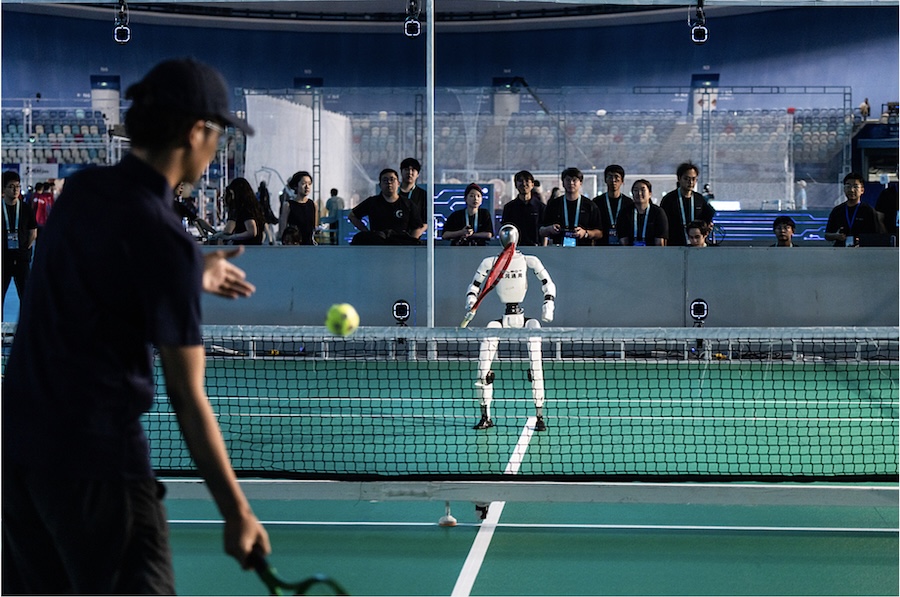
Tennis provided the stage for a striking demonstration of advances in artificial intelligence and robotics as humanoid robots developed by Beijing-based Galbot completed more than 100 consecutive autonomous exchanges with human players during the Second World Humanoid Robot Games in Beijing.
The exhibition, which Galbot billed as the world’s first live autonomous humanoid robot tennis match, took place during the Games’ opening festivities. Unlike scripted robotic demonstrations, Galbot said its AstraTennis system allowed the robots to independently perceive the ball, make decisions and execute shots in real time without teleoperation.
On court, the robots demonstrated an unexpectedly broad tennis repertoire, including serves, forehands, backhands, returns, baseline rallies and net play. They also competed alongside human players in doubles, requiring the machines to continually adjust their positioning and shot selection as points developed.
Former world No. 15 and Wimbledon semifinalist Zheng Jie was among the human players taking part. During the demonstration, a Galbot robot traded forehands and backhands with Zheng and responded to different spins and trajectories. Reports from Beijing indicated that serves exceeded 100 kilometers per hour. In one sequence, the robot lost its balance while pursuing a difficult ball, fell backward and then returned to its feet to continue play.
The 100-plus-shot rally is particularly notable because tennis presents a complex test for autonomous robotics. A machine must identify and track a rapidly moving ball, predict its trajectory and bounce, reposition its entire body and coordinate a racquet swing—all while responding to changing speed, spin and placement.
Galbot positioned the demonstration as an example of the emerging field of “embodied AI,” in which artificial intelligence moves beyond software and digital environments to perceive and interact with the physical world. The company compared the development to AlphaGo’s landmark 2016 victory over Go champion Lee Sedol, arguing that increasingly capable humanoid robots could represent another major step in AI’s evolution.
The tennis exhibition was part of a much larger showcase of humanoid robotics at the Beijing Games, where more than 2,000 robots are participating in sporting and real-world task competitions. Events range from running and soccer to industrial assembly, restaurant service and emergency-response challenges.
While Galbot’s record and autonomy claims have not been independently verified, the tennis demonstration offers a compelling glimpse at how quickly robotics is progressing from carefully choreographed movements toward machines capable of reacting dynamically to human opponents in one of sports’ fastest and most technically demanding environments.